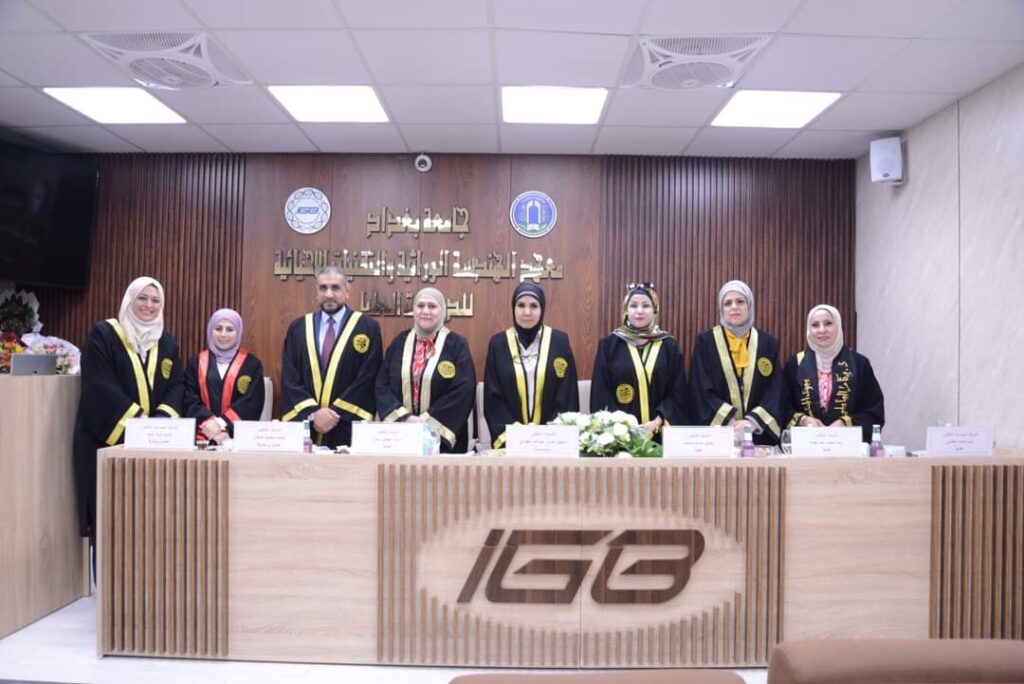
The Director General of the Center Speaks on a PhD dissertation
The Director General of the Biotechnology Research Center at Al Nahrain University, Prof. Dr. Mohammed Mahmoud Farhan, attended a doctoral thesis defense at the Genetic Engineering and Biotechnology Institute for Graduate studies-university of Baghdad. The work of the student Farah Farouk Hassan, entitled “Evaluation of Toll-like Receptor 4, Interleukin 18, and miR-126 as Predictive Biomarkers in a Sample of Iraqi Women with Breast Cancer”, was explained in the discussion hall of the institute.
The objectives of the study were to confirm the possibility of TLR4 and IL-18 and miRNA-126 as breast cancer-specific biomarkers among the Iraqi women population. The study looked into employing those predictive biomarkers for the early breast cancer diagnosis and management in Iraqi women who are apparently healthy but are at high risk of developing more aggressive stage 31.
The study period went from late October 2022 to early August 2023, during which all patients attended the Oncology Unit at Al-Yarmouk Teaching Hospital. The samples were taken and changes in age groups of 25-34 age and 35-44 age, 45-54 age, 55-64 age, and 65-74 age were developed. Among non-patients, the average age was 47.60 ± 11.70 years, among patients treated for the tumor the average age was 51.40 ± 10,06 years, and the average age among untreated restrained was 53.34 ± 9.51 years, with the least percentage in the 25-34 age category.
The study found that the concentration of IL-18 was lower in the healthy control group (93.44 ng/L) compared to the treated group (99.96 ng/L) and the untreated group (122.72 ng/L), with a
significant difference in the untreated group (p = 0.001).
The study recommended that the gene expression of TLR4 and IL-18, as well as their serum concentrations, were higher in patients compared to the healthy control group. In contrast, the gene expression of miR-126 was lower in patients compared to the healthy control group. This indicates a potential correlation between immune stimulators (TLR4 and IL-18) and, possibly indirectly, with the gene expression of miR-126-5p
